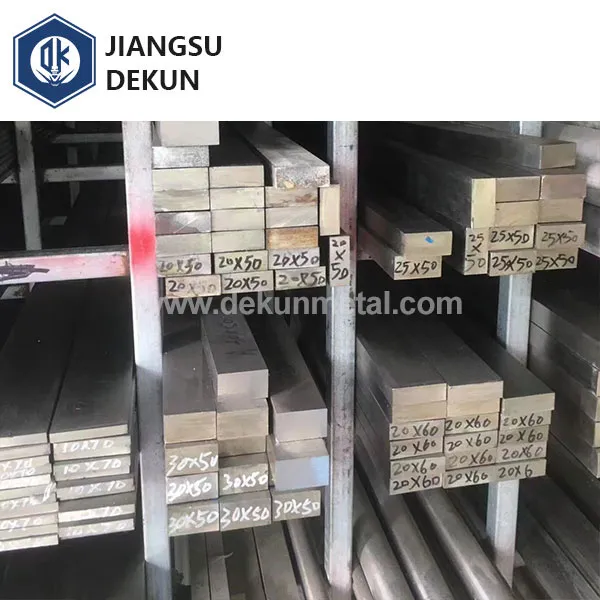
304 Stainless Steel Square Bar
video

304 Stainless Steel Square Bar

The 304 stainless steel square bar is widely recognized as the most commonly used stainless and heat-resisting steel. It possesses remarkable corrosion resistance against various chemical corrodents, making it suitable for use in both industrial atmospheres and harsh environments. Additionally,...
Send Inquiry
Chat Now

Description

Technical Parameters

The 304 stainless steel square bar is widely recognized as the most commonly used stainless and heat-resisting steel. It possesses remarkable corrosion resistance against various chemical corrodents, making it suitable for use in both industrial atmospheres and harsh environments. Additionally, this stainless steel square bar exhibits excellent working properties, maintaining its strength and durability even under extreme high and cold temperatures. It boasts exceptional formability, allowing for easy shaping and manipulation, and can be effortlessly welded using the conventional welding techniques. It is worth noting that the 304/304L dual certification further attests to its quality and reliability.

DEKUN Metal offers a comprehensive range of 304 stainless steel square bar in various sizes, starting from 3.0 x 3.0 mm up to 100 x 100 mm. Our standard bar length is 5.8m or 6m, and we can also manufacture bars with max length up to 12m. Whether you're looking for a specific size or length, you can count on us to deliver high-quality stainless steel square bars that meet your exact requirements. With our extensive experience and expertise in the industry, we ensure that every product we manufacture adheres to the highest standards of quality and precision. Contact us today to discuss your stainless steel square bar needs.

304 Stainless Steel Square Bar-DEKUN


Technical Specification

Product Name

304 Stainless Steel Square Bar

Standard

There are several standards that are utilized in the manufacturing of stainless steel products. These include ASTM A479, ASTM A276, ASTM A484, ASTM A582, ASME SA276, ASME SA484, GB/T1220, GB4226, among others. Each of these standards specifies particular requirements that must be adhered to in the production of stainless steel products.
ASTM A479 is a standard that outlines the requirements for stainless and heat-resisting steel bars and shapes. ASTM A276, on the other hand, focuses on the requirements for stainless steel bars and rods. ASTM A484 provides the general requirements for stainless steel bars, billets, and forgings.
ASME SA276 and ASME SA484, on the other hand, are American Society of Mechanical Engineers standards that outline the requirements for stainless steel bars and shapes, as well as the general requirements for stainless steel forgings. GB/T1220 and GB4226 are Chinese standards that specify the requirements for stainless steel rods, bars, and wires.
Overall, these standards play a crucial role in ensuring that stainless steel products are manufactured according to specific requirements, which helps to guarantee their quality, durability, and performance. Manufacturers and consumers alike value these standards for their ability to ensure consistently high-quality and reliable products.

Material

304L, 304, 317L, 317, 316, 316L, 309S, 310S, 321, 201, 202, 301.
The above list comprises different types of stainless steel grades commonly used in various industries. These grades possess unique chemical compositions and properties, making them suitable for specific applications.
Starting with 304L, it is a low carbon variant of 304 stainless steel. This grade offers excellent corrosion resistance and is widely used in the construction and automotive industries.
Next is 304, which is the most common stainless steel grade. It is known for its versatility, high corrosion resistance, and ease of fabrication. 304 is extensively utilized in kitchen appliances, food processing equipment, and architectural structures.
Moving on to 317L, it is a molybdenum-bearing austenitic stainless steel with enhanced corrosion resistance. This grade finds applications in chemical plants, pulp and paper mills, and other environments with aggressive media.
Following 317L, we have 317, which is similar but lacks the low carbon content. It also exhibits excellent corrosion resistance and is particularly suitable for handling acidic solutions.
Then we have 316 and 316L, both of which are widely used in marine environments due to their superior resistance to corrosion from saltwater and chemicals. These grades are extensively utilized in shipbuilding, offshore oil rigs, and desalination plants.
Moving towards 309S, it is a heat-resistant austenitic stainless steel grade. It offers high strength and oxidation resistance at elevated temperatures, making it suitable for furnace components and heat exchangers.
Next is 310S, a high-temperature grade that offers excellent oxidation resistance and is commonly used in heat treatment equipment and power generation plants.
Coming to 321, it is a stabilized stainless steel grade with titanium content, providing resistance to intergranular corrosion. It is often used in applications requiring elevated temperatures and prolonged exposure to corrosive environments.
Lastly, we have 201 and 202, which are considered low-cost alternatives to traditional stainless steel grades. These grades find applications in cookware, decorative materials, and some architectural structures.
In summary, the aforementioned stainless steel grades vary in their composition and properties, catering to diverse industrial requirements. Each grade has its unique advantages and finds extensive use in different sectors.

201, 202, 410, 420, 430, S20100, S30400, S30403, S30908, S31008, S31600, S31635, 321, 329, 347, 347H, and so on. These are just some of the different types of materials and alloys that can be found in various industries. They each have their own unique properties and uses in different applications.
For instance, 201 and 202 are both austenitic stainless steels that are commonly used in cookware and food processing equipment. They are resistant to corrosion and have good thermal conductivity. On the other hand, 410 is a martensitic stainless steel that is often used in applications where high strength and hardness are required, such as in cutlery and surgical instruments.
420 and 430 are also martensitic stainless steels, but with lower carbon content than 410. They are often used in the production of blades, valves, and pump parts due to their corrosion resistance and good mechanical properties.
S20100 is a grade of stainless steel that falls under the austenitic family. It has good resistance to corrosion, heat, and oxidation and is commonly used in appliances, chemical equipment, and architectural applications. S30400 and S30403 are types of stainless steel known as 304 and 304L, respectively. They have excellent corrosion resistance and are widely used in food processing, automotive, and pharmaceutical industries.
S30908 and S31008 are grades of stainless steel that belong to the austenitic family. They have high tensile strength, good impact resistance, and excellent resistance to high temperatures. These properties make them suitable for use in heat exchangers, furnace parts, and other high-temperature applications.
S31600 and S31635 are both variants of stainless steel known as 316 and 316Ti. They have superior corrosion resistance and are often used in marine environments and chemical processing plants.
These are just a few examples of the wide range of materials available in the market. Each grade and alloy have their own unique properties and applications. It is important to carefully select the right material for a specific project to ensure optimal performance and longevity.

Size

1mm*1mm~800mm*800mm

Length

2m, 5.8m, 6m, or as required.

Surface

Polishing, sand blast, bright, hair line, black, peeled - these are some of the words that can be used to describe the various finishes available for metal surfaces. When a metal surface is polished, it is made smooth and shiny through the use of polishing compounds and abrasive materials. Sand blasting, on the other hand, involves the use of high-pressure air to propel sand or other abrasive materials onto the metal surface, giving it a textured finish. A bright finish refers to a reflective and glossy surface, while a hairline finish is characterized by fine and parallel lines that give a subtle texture. Lastly, peel finish is achieved by removing the outermost layer of the metal, revealing a clean and pristine surface beneath. These different finishes offer a range of aesthetic options for metal products, allowing customers to choose the look that best suits their preferences.

Application

In today's world, stainless steel bars have become an essential material in a variety of industries, such as metal utensils, shipbuilding, petrochemical, machinery, medicine, food, electricity, energy, construction and decoration, nuclear power, aerospace, and military. Its popularity and widespread use are mainly due to its exceptional properties, including durability, corrosion resistance, and high strength. These qualities make it suitable for use in various applications, ranging from the construction of machinery and buildings to the production of household items. Despite being a metal, stainless steel's versatility and functionality make it an indispensable material for many industries.


Tolerance for Stainless Cold Drawn Square Bar

Cold Drawn SS Square Bar Tolerances(mm)

Plus

Minus

3.0 ~ 8.0

0

0.05

8.0 ~ 12.7

0

0.07

12.7 ~ 25.4

0

0.10

25.4 ~ 50.8

0

0.15

50.8 ~ 76.2

0

0.20

Note: Our Minimum Tolerance: 0.01mm


Tolerance for Stainless Steel Hot Rolled Square Bar

Hot Rolled SS Square Bar Tolerances(mm)

Plus

Minus

20.0 ~ 25.4

0.22

0.22

25.4 ~ 28.6

0.25

0.25

28.6 ~ 31.8

0.28

0.28

31.8 ~ 35.0

0.30

0.30

35.0 ~ 38.1

0.36

0.36

38.1 ~ 50.8

0.40

0.40


Hot Tags: 304 stainless steel square bar, China 304 stainless steel square bar manufacturers, suppliers, factory

Send Inquiry